
The short answer
Good concrete depends on an unbroken chain: batching with reliable cement handling, transport in enough transit mixers to keep the pump fed, pumping to the point of placement, vibration to remove entrapped air, and screeding to level. A weak link anywhere shows up as cold joints, honeycombing or an uneven slab.
1. Batching and cement handling
At the batching plant, screw conveyors carry cement and fly ash from silos to the weigh hopper. Silo filters keep the silo at safe pressure during filling, and flow aids such as bin aerators stop cement arching over the outlet.
2. Sizing the transit mixer fleet
The pump should never wait for concrete. Work out the fleet from the pour rate and the round-trip time.
| Pour rate | Round trip | Mixer size | Mixers needed |
|---|---|---|---|
| 30 m³/h | 60 min | 6 m³ | 5 |
| 60 m³/h | 75 min | 7.5 m³ | 10 |
| 90 m³/h | 90 min | 9 m³ | 15 |
Mixers needed = pour rate × round-trip hours ÷ mixer capacity. Add one or two as a buffer.
3. Pumping and placing
Boom pumps place concrete directly on slabs and in columns. Line pumps push concrete through pipelines to upper floors and long distances. Place in layers that your vibrators can compact fully.
4. Vibration
Internal vibrators remove entrapped air so concrete reaches its design strength and a dense, durable surface. High-frequency electric pokers powered by a frequency converter keep a constant speed under load. Insert vertically at regular spacing so zones of influence overlap, and withdraw slowly.
5. Screeding and finishing
Wet screeds level smaller slabs between forms; truss screeds span wider bays and road pavements. Power trowels then close and harden the surface.
Equipment for this application
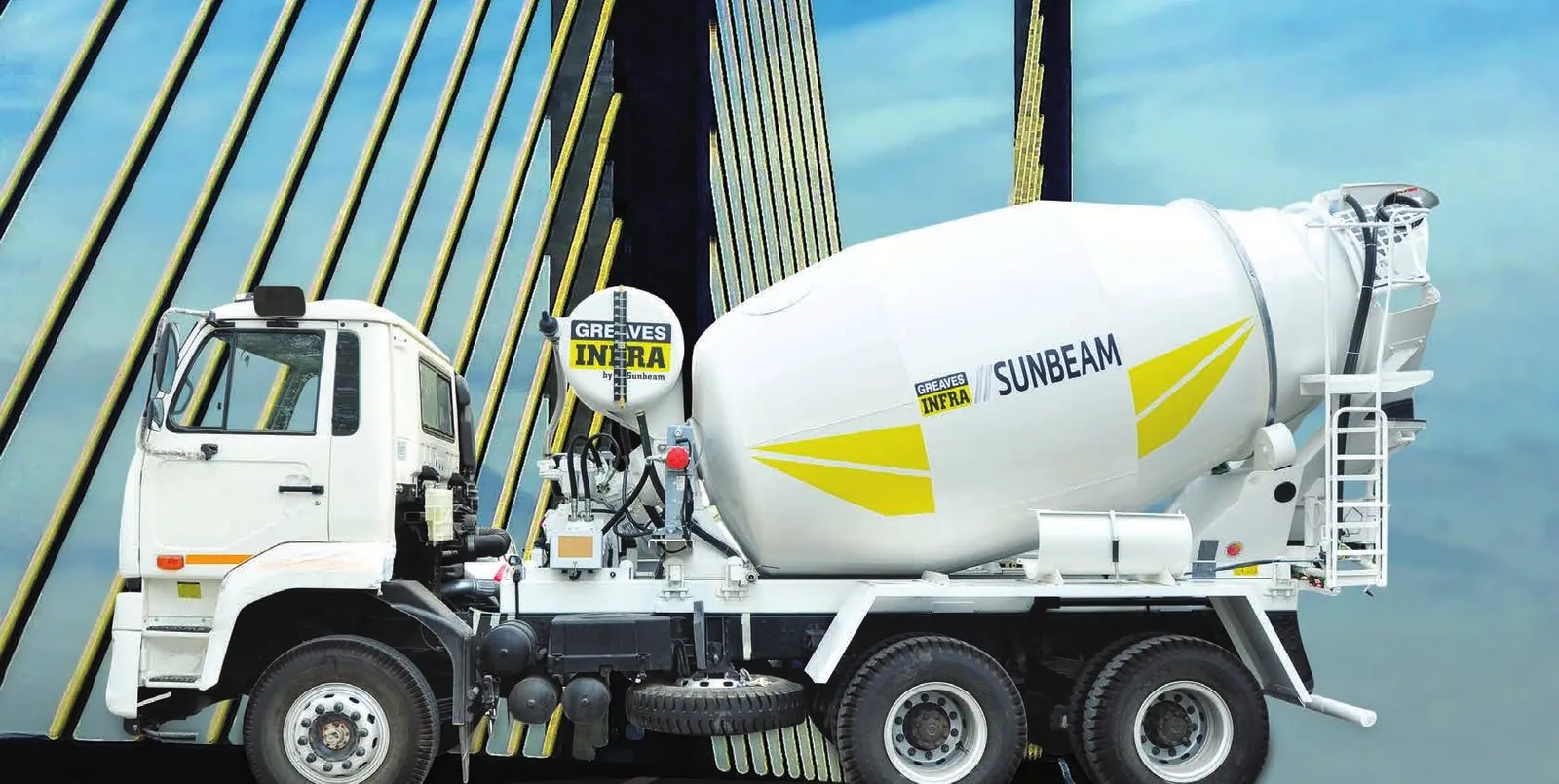
- Sunbeam transit mixers, 4–9 m³, and concrete pumps
- Wacker Neuson internal vibrators, converters and screeds
- WAM Group screw conveyors, silo filters and flow aids
- Sigma bar bending and cutting machines for the reinforcement
Frequently asked questions
How many transit mixers do I need for a continuous pour?
Fleet size = pour rate (m³/h) × round-trip time (h) ÷ mixer capacity (m³). A 60 m³/h pour with a 75-minute round trip and 7.5 m³ mixers needs 10 mixers. Add one or two for traffic and breakdowns.
How far apart should I insert an internal vibrator?
Insert the poker vertically at regular spacing so each zone of influence overlaps the last, and let it sink through the full layer into the one below. Withdraw slowly so the concrete closes behind it. Larger poker diameters have a wider zone of influence and allow wider spacing.
Why use high-frequency electric vibrators?
High-frequency vibrators powered by a frequency converter keep a constant speed under load, so compaction stays consistent through the pour, and one converter can run several pokers.
Wet screed or truss screed?
Wet screeds suit smaller slabs and pours between forms where an operator works close to the surface. Truss screeds span wider bays and give flatter results on large slabs and road pavements.