
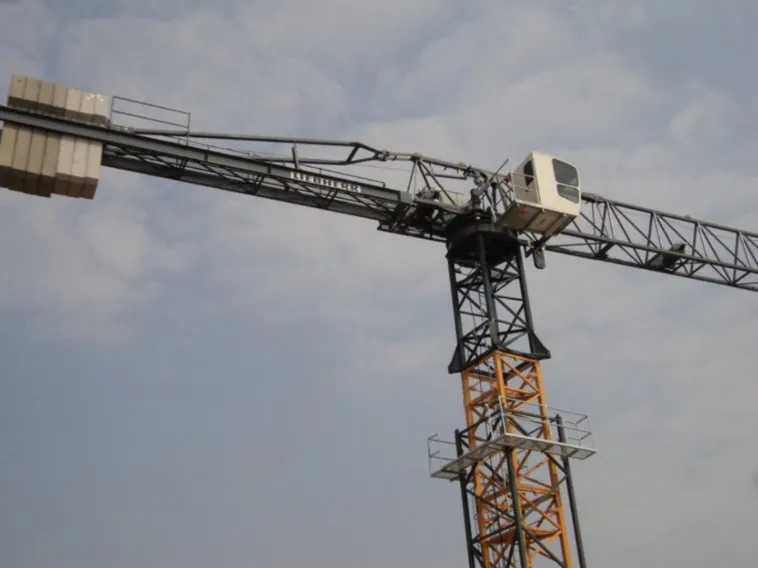
The short answer
Choose a flat-top crane for open sites and when several cranes must work close together: it is quick to erect and has no tower head. Choose a luffing jib crane for tight city sites, near neighbouring buildings or under airspace limits, because its jib raises to reduce the slewing radius. Then size the crane by the heaviest load at the longest radius and the hook height you need.
Flat-top or luffing jib?
| Flat-top | Luffing jib | |
|---|---|---|
| Best for | Open sites, multiple cranes, large footprints | Dense urban sites, tight boundaries, overlapping cranes |
| Jib | Fixed horizontal jib | Jib raises and lowers |
| Erection | Fast, fewer components | More complex |
| Oversailing neighbours | Jib sweeps a full circle | Jib can be raised to limit the radius |
Sizing the crane
List the heaviest lifts, such as precast elements, rebar cages, formwork systems and plant, with the radius at which each must be lifted. The crane's load chart must cover every lift with a margin. Then set the hook height for the finished building plus clearance, and check the coverage of the whole site.
Planning the site
Plan access for erection and dismantling by mobile crane, the foundation or tie-ins to the structure, power supply, and the operator's view of the load. Where cranes overlap, an anti-collision system and a clear lifting plan are essential.
Foundations
The foundation must carry the crane's vertical load, overturning moment and slewing torque in service and storm conditions, for the specific crane configuration and soil.
Equipment for this application
- Liebherr flat-top and luffing jib tower cranes
- UltraWis vision systems that give the operator a real-time view of the load
- Conteknik Engineering crane foundation and tie-in design
Frequently asked questions
What is the difference between a flat-top and a luffing jib tower crane?
A flat-top crane has a fixed horizontal jib and no tower head, which makes it quick to erect and lets several cranes work close together. A luffing jib crane raises and lowers its jib, so it can work in tight city sites and avoid oversailing neighbouring buildings.
How do I size a tower crane for my project?
Start from the heaviest lift at the longest radius you need, the hook height to the top of the building plus clearance, and the area the crane must cover. The crane's load chart must handle the heaviest load at its radius with a safety margin.
Does a tower crane need a special foundation?
Yes. The foundation must resist the crane's vertical load, overturning moment and slewing torque in service and storm conditions. It is designed for the specific crane, configuration and soil. Our engineering team can design it.