
The short answer
Most road aggregate circuits use three stages: a jaw crusher for primary reduction, a cone crusher for secondary crushing and shape, and a multi-deck screener to split the product into fractions. Oversize goes back to the cone. Add an impact or VSI stage when you need manufactured sand.
What each stage does
Primary crushing. The jaw crusher takes run-of-quarry rock and reduces it to a size the next stage can accept. It is robust and tolerant of large, hard feed, but produces flaky product on its own.
Secondary and tertiary crushing. Cone crushers reduce further and improve particle shape. Run them choke-fed for the best cubicity. In softer stone or recycled concrete an impact crusher can replace the cone.
Screening. A two- or three-deck screen splits the product into saleable fractions and returns oversize. Screen media choice drives both accuracy and running cost.
Choosing a crusher by rock type
| Material | Primary | Secondary | Notes |
|---|---|---|---|
| Granite, basalt, quartzite | Jaw | Cone | Hard and abrasive. Impact crushers wear fast here. |
| Limestone, sandstone | Jaw or impact | Impact | Softer stone. Impactors give good shape at low cost. |
| River gravel | Jaw if oversize present | Cone | Often screened first to remove natural fines. |
| Concrete and C&D waste | Jaw or impact | Impact | Remove rebar with a magnet. Pre-screen soil. |
Mobile or stationary?
Tracked mobile plants move with the work. On a highway package that saves trucking aggregate tens of kilometres; in a quarry it lets you crush at the advancing face. A stationary plant still wins on a single long-life site with steady, high tonnage and grid power.
Equipment for this application
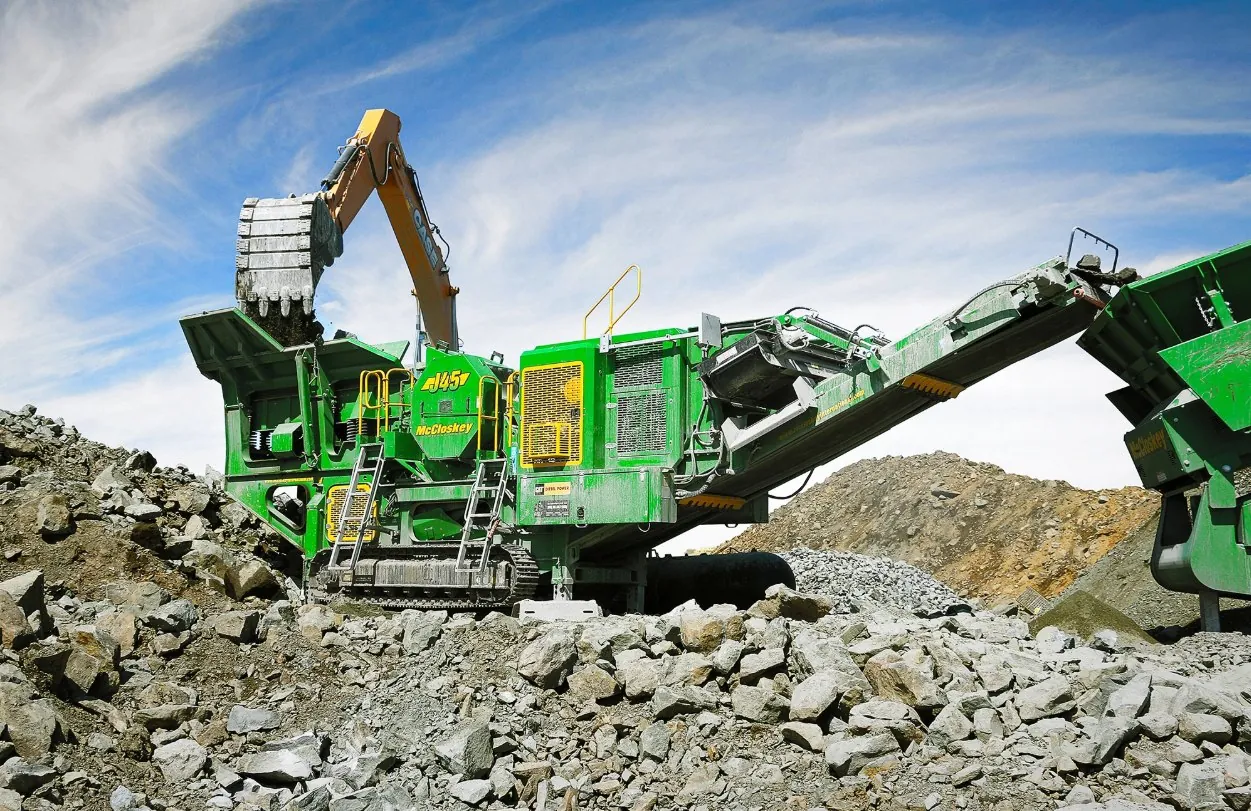
- McCloskey tracked jaw, cone and impact crushers
- Liebherr wheel loaders and excavators for feeding and stockpile management
- WAM Group dust collection and bulk handling for fines and fixed plant
Frequently asked questions
What is the difference between a jaw crusher and a cone crusher?
A jaw crusher squeezes rock between a fixed and a moving jaw and handles large feed for primary reduction. A cone crusher gyrates a mantle inside a concave and is used for secondary and tertiary crushing to produce smaller, better-shaped aggregate.
Which crusher gives the best shape for concrete aggregate?
Cone crushers in a well-fed, choke-fed condition and impact crushers both produce cubical aggregate. For manufactured sand, a vertical shaft impactor is commonly added as the final stage.
What size is M-sand?
Manufactured sand for concrete in India is graded 0–4.75 mm and should meet IS 383 grading and fines limits.
Should I buy a mobile or a stationary crushing plant?
Choose tracked mobile plant when the work moves along a highway, when a quarry face advances, or when you recycle on demolition sites. Choose a stationary plant for a single long-life site with high, steady tonnage.
Can construction and demolition waste be crushed into usable aggregate?
Yes. Jaw or impact crushers with magnetic separation and screening turn concrete and masonry into recycled aggregate for sub-base, fill and non-structural concrete.